

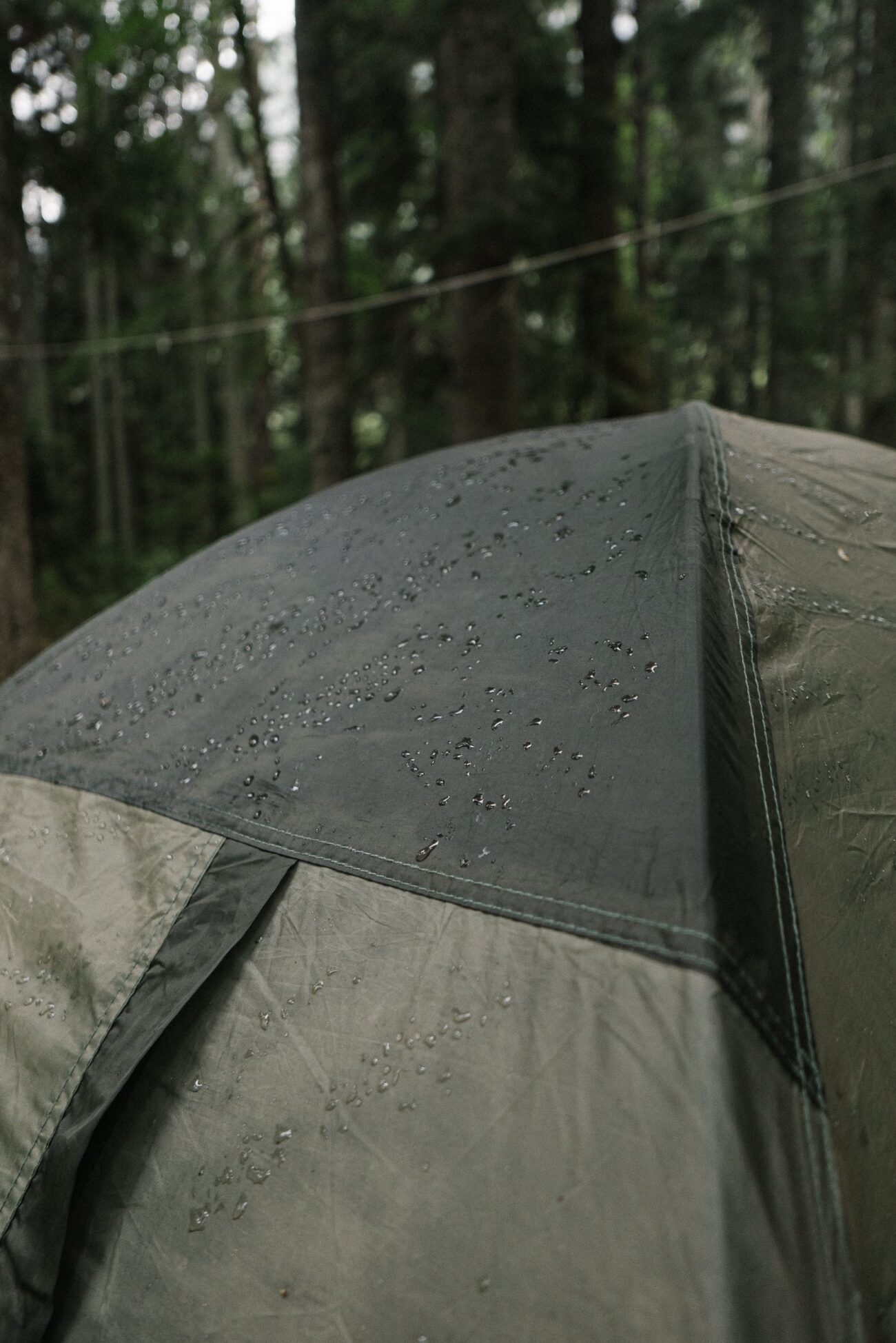
Ask any group of ultralight hikers whether Dyneema is waterproof and you’ll get two confident, completely different answers in the same breath: “Yes, it’s a laminate, nothing gets through it” and “No way, I had a Dyneema tarp leak on me.” Both people are technically right, which is exactly why this question causes so much confusion. The fabric and the finished product are not the same thing, and understanding the difference is the only way to actually judge whether a piece of Dyneema gear will keep you dry.
What Actually Makes Dyneema Waterproof
Dyneema Composite Fabric (DCF), still called Cuben Fiber by longtime hikers, is not a woven fabric with a waterproof coating sprayed or brushed onto it the way silnylon or silpoly are. It’s a laminate. A grid of ultra-high-molecular-weight polyethylene (UHMWPE) fibers is sandwiched between one or two thin films, usually polyester or a similar plastic membrane, and the whole stack is bonded together under heat and pressure. That film layer is what stops water, and it’s a continuous, non-porous barrier rather than a coating sitting on top of a woven base.
This matters because coatings wear. Silicone and polyurethane coatings on nylon are applied to the outside (or inside) of a woven textile that is not itself waterproof. Over years of UV exposure, abrasion, and packing, those coatings crack, flake, and eventually let water soak straight through the underlying weave. DCF doesn’t have that failure mode in the same way, because the waterproofing isn’t a surface treatment, it’s baked into the structure of the material itself. As long as the laminate stays intact, the fabric itself does not “wet out.”
The Fabric Is Waterproof. Your Seams Might Not Be.
Here’s where most of the confusion, and most of the actual leaks, come from. A single flat sheet of DCF is essentially impermeable to liquid water. A finished tent, tarp, or pack is not a single flat sheet. It’s multiple panels joined together, and every join is a potential weak point:
- Taped seams: Most reputable DCF shelters (Zpacks, Tarptent, Hyperlite Mountain Gear and similar brands) bond panels using DCF tape rather than sewing them, and the seams are welded or taped at the factory before the product ships. Done correctly, these seams are watertight without any extra sealing from the buyer.
- Sewn seams: Some budget DCF gear, and most DIY projects, stitch panels together with a needle and thread. Every stitch punches a hole through the laminate, and thread does not fill that hole the way the surrounding fabric does. Sewn DCF seams need to be taped over the stitching, or they will leak at exactly the rate you’d expect from a row of tiny needle holes.
- Attachment points: Grommets, tieouts, and stake loops are usually reinforced with extra layers, but they are still places where hardware meets fabric, and that junction is only as good as the adhesive and reinforcement used there.
So when someone says their Dyneema tarp “leaked,” it’s worth asking where. In the vast majority of cases, water isn’t coming through the fabric panel, it’s finding a seam, a stitch hole, or a stake loop that wasn’t sealed properly.
Hydrostatic Head Numbers Don’t Mean What You Think
Traditional waterproof fabrics are rated by hydrostatic head, essentially how many millimeters of standing water a fabric can resist before it starts to leak. It’s a useful number for coated nylon because it tells you how much the coating is doing. Applying that same number to DCF is misleading, because the test was designed around porous, coated textiles, not a continuous plastic film laminate. You’ll sometimes see DCF listed with very high hydrostatic head figures, but the practical takeaway is simpler than the number suggests: an intact sheet of DCF isn’t going to fail under rain, wind-driven spray, or ground moisture the way a worn-out coating does. If a DCF product is going to let water through, it is almost always going to be at a seam, a puncture, or a spot where the laminate has delaminated, not through the body of the fabric.
Where Dyneema Gear Actually Fails at Keeping Water Out
Understanding the real failure points helps you buy smarter and maintain your gear better:
- Delamination: Repeated hard folding along the same crease lines, especially in cold temperatures, can eventually separate the film from the fiber grid. Once that happens, that specific spot can wick or let water through even though the rest of the panel is fine.
- Abrasion and pinholes: DCF resists tearing extremely well thanks to the UHMWPE fiber grid, but it’s not immune to small punctures from sharp rocks, branches, or careless packing. A pinhole is a pinhole regardless of what the surrounding fabric is rated for.
- Aging tape adhesive: On older shelters, the adhesive bonding seam tape can degrade faster than the fabric itself, especially at high-stress points like ridgeline seams or corner patches. This is a maintenance item, not a fabric defect.
- User error: Pitching a tarp too flat, letting a low point pool water on top of a fly, or skipping a factory recommendation to reinforce a seam are all ways to create a “leak” that has nothing to do with the material.
If you want to keep a DCF shelter performing the way it did on day one, our guide to cleaning, reproofing, and storing Dyneema and silnylon gear covers how to spot and deal with exactly these issues before they turn into a wet night.
How This Stacks Up Against “Waterproof” Nylon Claims
Coated nylon and polyester fabrics like silnylon and silpoly are genuinely waterproof when new, but that waterproofing is a wearing part, not a permanent property of the material. Silicone coatings can also cause the fabric to sag when wet, since the coating doesn’t stretch the same way the base fabric does under load, which is a separate issue from leaking but still affects how a shelter performs in a storm. We’ve broken down that side-by-side comparison in more detail after years of testing both materials in wet conditions in our piece on Dyneema vs. silnylon after many wet trips, and for the full technical rundown on why the fabric costs what it does, see our complete guide to Dyneema fabric. DCF’s main practical advantage isn’t a higher waterproof “rating,” it’s that the waterproofing doesn’t degrade in the same predictable way a coating does, and the fabric holds its shape under tension in the wind and rain instead of sagging.
Frequently Asked Questions
Do I need to seam seal a Dyneema tent?
If it came from a reputable manufacturer with factory-taped seams, generally no. If you sewed it yourself or bought a budget product with visible stitching along the seams, yes, those stitch lines need to be taped or sealed before you trust it in real rain.
Can Dyneema fabric leak over time?
The fabric panel itself is very resistant to failure, but delamination from repeated hard creasing, abrasion punctures, and aging seam tape adhesive can all create leaks in gear that’s been used hard for several seasons.
Is Dyneema more waterproof than silnylon?
Both are effectively waterproof when the product is new and intact. Dyneema’s advantage is durability of that waterproofing over time and resistance to sagging when wet, not a dramatically higher waterproof rating on day one.
What’s the actual waterproof rating of Dyneema?
Manufacturers sometimes publish hydrostatic head figures, but the test was built for coated fabrics and doesn’t translate cleanly to a laminate. In practical terms, an intact DCF panel is not the part of your shelter that’s going to fail in the rain.
The Bottom Line
Dyneema fabric itself is waterproof by design, not by coating, which is exactly why it holds up so well over the life of a shelter or pack. The leaks that give the material a bad reputation almost always trace back to seams, stitch holes, punctures, or worn tape adhesive rather than the laminate failing on its own. If you’re shopping for your next shelter and trying to weigh whether that durability is worth the price premium over silpoly or silnylon, our breakdown of Dyneema vs. Kevlar for ultralight gear is a good next stop for understanding where this material really earns its keep.
One thing that makes it a lot easier to track how your gear is actually holding up trip to trip is keeping a real inventory of what you own and how much it weighs. That’s the whole idea behind FeatherPack, an iOS app where you photograph one piece of gear at a time and it automatically logs it, with weight, into your gear closet, then lets you build trip-specific pack lists from there. It’s a simple way to notice when an aging shelter or worn seam tape is adding weight or worry it shouldn’t be. Have you had a Dyneema leak that turned out to be a seam instead of the fabric? Drop a comment below, it’s one of the most common gear mix-ups we hear about.
